reabc/Federal Habeas Corpus for State Prisoners - D Michael Salerno/Federal Habeas Corpus for State Prisoners - D Michael Salerno.pdf
Web PDF • Imposed PDF• Raw TXT (OCR)


![These rules also apply to a prisoner who neads to file second OF succescive habens eorpus” action “adnd actually ’use’ them, For this reason a future legal booklet is planmed on the topic of second and successive habeas corpus actions but will also be treated herein in There are a fev different sections under vhich a prisoner may ile for a habeas corpus. A state prisoner files under section 2254; a federal prisoner files under 2255 and a variety of prisoner actions might fall under the broad scope of 2244 itself. Research will show when & 2204 wight apply. There is a one year time limitation for filing a habeas corpus action due to federal legislation in the AEDPA. The limitation has exceptions that are rare but may apply. Research on the issue will uncover whether it applies to an individual’s situation. If ‘you or another prisoner you know needs help learming about. how to use the law Library or how to write a motion appeal, please pass on the information that the or an first Booklet, How to use the law lit and write e e gy end wlee v I om_law_work Tee Books to prisoners outfits. that booklet, the first in the criminal law series, will give the knowledge and confidence needed to begin finding the way the courts. A list of other Pmfi: Press /D. M. Salermo booklets and zines and some p] they may be requested from is found at the back of this booklet. 1If you write and ask for free information from a books to prisoners outfit, please donate any amount you can afford or embossed envelopes or other stamps. Most books to prisoner’s places are staffed by volunteers who often pay for postage and for copies and the books themselves out of their own pockets. Let’s help them help us. avanti -- Alvays forvard D. M. Salerno, January 2014](Federal Habeas Corpus for State Prisoners - D Michael Salerno 5.png)



![] e § E E 1 : R ORRRESS 8 ¢ E g I g E icate of appealability is issued you will a petition for a writ of certiorari with the . Supreme Court. Though there are no forms available a request for a federal district or federal request for a certificate of appealability are forms available for Filing a petition for a writ of certiorari. To i g g i get forns you would mail a letter of request to the Clerk of the United States Supreme Court, which might sound like this: ’ Office of the Clerk Please send me the forms and instructions needed to file a petition for a writ of certiorari with your court. Please also send me a current copy of the rules of court. The Clerk will send you a packet including the fill in the blank forms, instructions and the rules of the U.S. 13](Federal Habeas Corpus for State Prisoners - D Michael Salerno 13.png)
![Rules Governing Section 2254 Cases in the United States District Courts Section 2254 Rule 1 Rule 1. Scope. (a) Cases Involving a Petition Under 28 U.S.C. § 2254. These rules a petition for a writ of habeas corpus filed in a United States district court under 28 U.S.C. § 2254 by: (1) a person in custody under a state-court judgment who seeks a determination that the custody violates the Constitution, laws, o treaties of ‘the United States; and (2) a person in custody under a state-court or federal-court judgment who seeks a determination that fture custody under a state-court judgment ‘’would violate the Constitution, laws, or treaties of the United States. (b) Other Cases, The district court may apply any or all of these rules to a habeas corpus petition not covered by Rule I(a). [4mended effective Dec. 1, 2004] Section 2254 Rule 2 (8) Current Custody; Naring the Respondent. If the petitioner is currently in custody under a state-court judgment, the petition must name as respondent the state officer who has custody. (b) Future Custody; Naming the Respondents and Specifying the Judgment. If the petitioner is not yet in custody=-but may be subject to future custody~- under the state-court judgment being contested, the petition must name as respondents both the officer who has current custody and the attorey general of the state where the judgment was entered. The petition must ask for relief from the state-court judgment being contested. 15](Federal Habeas Corpus for State Prisoners - D Michael Salerno 15.png)
![Form. The petition must: 1) specify all the grounds for relief available to the petitioner; 2) state the facts supporting each ground; 3) state the relief requested; ) be printed, typewritten, or legibly handwritten; and S)knmndundupmn)tynfpajwybylthmflmflmhyapm thorized to sign it for the petitioner under 28 US.C. § 2242. ) Standard Form. The petition must substantially follow either the form pended to these rules or a form prescribed by a local district-court rule. 1e clerk must make forms available to petitioners without charge. ) Separate Petitions for Judgments of Separate Courts. A pefitioner who. ek relief from judgments of more than one state court must file a separate’ sition covering the judgment or judgments of each court. [Amended Tective Dec. 1, 2004.] Section 2254 Rule 3 ule3. Filing the Petition; Inmate Filing. ) Where to File; Copies; Filing Fee. An original and two copies of the tition must be filed with the clerk and must be accompanied by: (1) the applicable filing fee, o -](Federal Habeas Corpus for State Prisoners - D Michael Salerno 16.png)

![(¢) Reply. The peitioner may submit a reply to the respondent’s answer or other pleading within a time fixed by the judge. [Amended effective Dec. 1, 2004] Section 2254 Rule 6 Rule 6. Discovery. (&) Leave of Court Required. A judge may, for good cause, authorize a part o conduct discovery under the Federal Rules of Civil Procedure and may it the extent of discovery. If necessary for effective discovery, the judge ‘must appoint an attomey for a petitioner who qualifies to have counsel appointed under 18 U.S.C. § 3006A. (b) Requesting Discovery: A party requesting discovery must provide reasons for the request. The request must also include any proposed mmwn’ummmmmwm‘ and must specify any requested (¢) Deposition Expenses. If the respondent is granted leave to take a. deposition, the judge may require the respondent to pay the travel expenses subsistence expenses; and fees of the petitioners attomey to attend the deposition. [Amended effective Dec. 1, 2004 Section 2254 Rule 7 Rule 7. Expanding the Record. (2) In General. If the petition s not dismissed, the judge may direct the parties to expand the record by submitting additional materials relating to the petition. The judge may require that these materials be authenticated. (b) Types of Materials. The materials that may be required include letters predating the filing of the petition, documents, exhibits, and answers under 19](Federal Habeas Corpus for State Prisoners - D Michael Salerno 19.png)


![le 12. Applicability of the Federal Rules of Civil Procedure, The Federal * statutory provisions o these rules, may be applied to a proceeding ler these rules. [Amended effective Dec. 1, 2004; remumbered from Rule Dec. 1, 2009.] Model Forms Petition for Relief From a Conviction or Sentence By a Person in ite Custody * ’ ition for Relief From a Conviction or Sentence By a Person in State stody stition Under 28 U.S.C, § 2254 for a Writ of Habeas Corpus) 1. To use this form, you must be person who is currently serving a sentence under a judgment against you in a state court. You are asking for relief from the conviction or the sentence. 2. You may also yse this form to challenge a state judgment that imposed a sentence to be served in the future, but you must fill in the name of the state where the judgment was entered. If you ‘want to challenge a federal judgment that imposed a sentence to e scrved in the future, you should file a motion under 2§ U.S.C. §2255 inthe federal court that entered the judgment. 3. Make sure the form s typed or neatly written. 4. You must tell the truth and sign the form. If you make a false statement of a material fact, you may be prosecuted for perjury. 5. Answer all the questions. You do not need to cite law: You ‘may submit additional pages if necessary. If you do not fill out ™](Federal Habeas Corpus for State Prisoners - D Michael Salerno 22.png)




![(6) Did you receive a hearing where evidence was given on ‘your petition, application, or motion? Yes No (7) Result: (8) Date of result (if you know): (d)mdywmpulmhhighmmmmhvingjmisdicfim over the action taken on your petition, application, or motion? (1) First Yes No (2) Second Yes No petition: (3) Third Yes No (&) If you did not appeal to the highest state court having jurisdiction, *xplain why you did not: lz.Fmdfispcdfiqn,mcvnymmdmwhichywc]mflmwun xinghelflinviolnfiunofflwccmimfivn,llws,mmmofihel}nimd ‘he facts supporting each ground. CAUTION: To proceed in the federal court, you must ordinarily first exhaust (use up) your available state-court remedies on each ground on whichyomqmufim»ymefizegaumm.ifywm](Federal Habeas Corpus for State Prisoners - D Michael Salerno 30.png)




![4mended effective Dec. 1, 2004] In Forma Pauperis Declaration 1 Forma Pauperis Declaration 1 Forma Pauperis Declaration ‘nsert appropriate court) ’DECLARATTON Movant) OF REQUEST TO PROCEED N FORMA PAUPERIS ., declare that T am the movant in the above entitled case; that lmxppoflnfmymnfimmpomdwithmnbeing:eqlfiledmmfies, 2sts or give security therefor, I state that because of my poverty, I am aable to pay the costs of said proceeding or to give security therefor; that slieve I am entitled o relief. - Are you presently employed? s No If the answer is "yes,” state the amount of your salary or wages per onth; and give the name and address of your employer. If the answer is "no,” state the date of last employment and the amount of te salary and wages per month which you received. Have you received within the past twelve months any money from any of ‘e following sources? Business, profession or form ofslf-cmployment?](Federal Habeas Corpus for State Prisoners - D Michael Salerno 48.png)


![() Certificate of Appealability. (1) In a habeas corpus proceeding in which the detention complained of arises from process issued by a state court, or in a 28 US.C, § 2255 *proceeding, the applicant cannot take an appeal unless a cirouit justice or a circuit or district judge issues a certificate of appealability under 28 S.C. §2253(c). If an applicant files a notice of appeal, the district judge who rendered the judgment must cither issue a certificate of appealability or state why a certificate should not issue. The district cleck must send the certificate or statement to the court of appeals with the notice of appeal and the file of the district court proceedings. If the district judge has denied the certificate, the applicant may request a circuit judge to issue the certificate. (2) A request addressed to the court of appeals may be considered by a circuit judge or judges, as the court prescribes. If no cxpress request for a certificate is filed, the notice of appeal constitutes a request addressed to the judges of the court of appeals. (3) A certificate of appealability is not required when a state or its representative or the United States or its represcntative appeals. [Adopted 1967 last amended December 1, 1998.] 51](Federal Habeas Corpus for State Prisoners - D Michael Salerno 51.png)


Pauper's Press §'
This publication Was created to provide you with accurate
@nd authoritative information concerning the subject
(matter covered. It is offered with the understanding
that the publisher and author are not engaged if
rendering legal or other profesgional advice, and thil
{publication is'not a substitute for the advice of ‘art’
‘attorney. This.publication was mof necessarily prepa
by anyone licensed to practite law. If legal o other
professional advice is needed, a competent professiotal
should be sought. .
Written and Compiled by:
D. Michael Salerno
P,0. Box 57.#412-224 :
Marion Chio 43301 ‘
www. freesalerno.com
A Pauper's Press Publicarion
In conjunction with:
CT ABC / ABC Para-Legal Services
Redbird P.A./ Books 2 Prisoners
‘Tne Salerno Research Group
1sp Printing : February 2014
TABLE OF CONTENTS
Rule 1 : Scope - - s
Rule 2 : the Petition 5
Rule 3 : filing the Petition, Inmate filig ~ - 16
Rule 4 : Preliminary Review — —~ 7
Rule 5 : The Ansver and The Reply 8
Rule § : Discovery - 19
Rule 7 : Expanding the Record — -~ \a
Rule 8 : Evidentiary Hearing ~———u ——— 2.3
Rule 9 : Second or Successive Petitions ——— 2
Rule 10 : Povers of a Mag z!
z
zt
In forma Pauperis Declaration . Gg
w
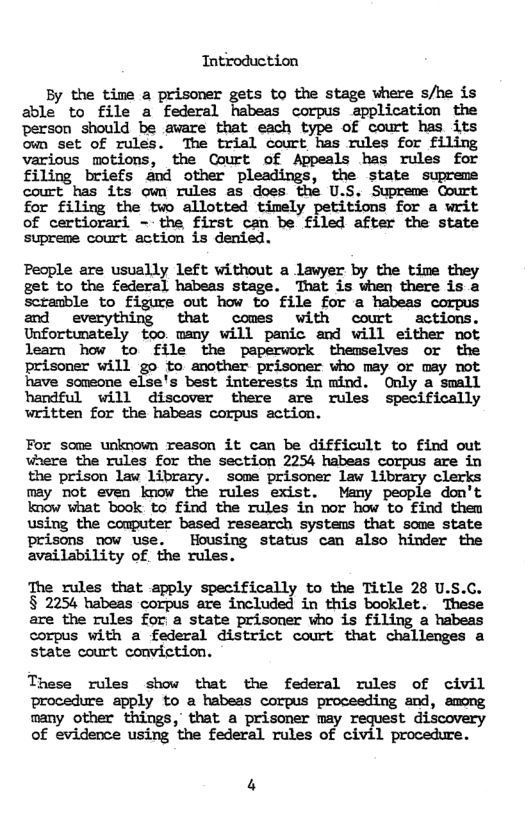
Introduction
By the time a prisoner gets to the stage where s/he is
able to file a federal habeas corpus application the
person should be aware that each type Of court has its
on set of rules. The trial court has rules for filing
various motions, the Court of Appeals has rules for
filing briefs and other pleadings, the state supreme
court has its own rules as does the U.S, Supreme Court
for filing the two allotted timely petitions for a writ
of certiorari - the first can be filed after the state
supreme court action is denied.
People are usually left without a lawyer by the time they
get to the federal habeas stage. That is when there is a
scramble to figure out how to file for a habeas corpus
and everything that comes with court actions.
Unfortunately too. meny will panic and will either not
lum}mtofflet!epnpemfldmelmotthe
to another prisoner who may or may not
havesurem\e se's best interests in mind. Only a small
handful will discover there are rules specifically
written for the habeas corpus action.
For some unknown reason it can be difficult to find out
where the rules for the section 2254 habeas corpus are in
the prison law library. some prisoner law library clerks
may not even know the rules exist. Many people don't
Yot What Dok to £ind the rules in nor bow 10 Find them
using the computer based research systems that some state
prisons now use. Housing status can also hinder the
availability of the rules.
The rules that apply specifically to the Title 28 U.S.C.
§ 2254 habeas corpus are i.mludagm this booklet. These
are the rules for a state prisoner who is filing a habeas
corpus with a federal district court that challenges a
state court conviction.
These rules show that the federal rules of civil
procedure apply to a habeas corpus proceeding and, among
many other things, that a prisoner may request
of evidence using the federal rules of civil procedure.
These rules also apply to a prisoner who neads to file
second OF succescive habens eorpus” action “adnd
actually 'use’ them, For this reason a future legal
booklet is planmed on the topic of second and successive
habeas corpus actions but will also be treated herein in
There are a fev different sections under vhich a prisoner
may
ile for a habeas corpus. A state prisoner files
under section 2254; a federal prisoner files under 2255
and a variety of prisoner actions might fall under the
broad scope of 2244 itself. Research will show when &
2204 wight apply.
There is a one year time limitation for filing a habeas
corpus action due to federal legislation in the AEDPA.
The limitation has exceptions that are rare but may
apply. Research on the issue will uncover whether it
applies to an individual's situation.
If ‘you or another prisoner you know needs help learming
about. how to use the law Library or how to write a motion
appeal, please pass on the information that the
or an
first Booklet, How to use the law lit and write
e e gy end wlee v I
om_law_work Tee
Books to prisoners outfits. that booklet, the first in
the criminal law series, will give the knowledge and
confidence needed to begin finding the way the
courts. A list of other Pmfi: Press /D. M. Salermo
booklets and zines and some p] they may be requested
from is found at the back of this booklet.
1If you write and ask for free information from a books to
prisoners outfit, please donate any amount you can afford
or embossed envelopes or other stamps. Most books to
prisoner’s places are staffed by volunteers who often pay
for postage and for copies and the books themselves out
of their own pockets. Let's help them help us.
avanti -- Alvays forvard
D. M. Salerno, January 2014
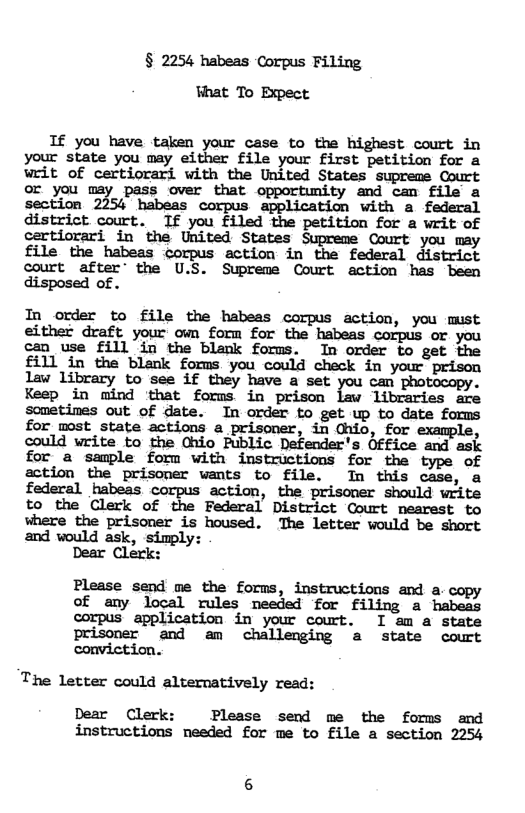
§ 2254 habeas ‘Corpus Filing
What To Expect
If you have taken your case to the highest court in
your state you may either file your first petition for a
writ of certiorari with the United States suprens Court
or ‘may s over that opportunity can a
Seciion D5 habsas corpus srplication with &
district court. If you filed the petition for a writ of
certiorari in the United States Supreme Court you may
file the habeas corpus action in the federal dis
court after’ the U.S. Supreme Court action has been
disposed of.
you
Please send me the forms, instructions and a. copy
of any local rules needed for filing a habeas
corpus application in your court. I am a state
prisoner and am challenging a state court
conviction
The letter could alternatively read:
Dear Clerk: Please send me the forns and
instructions needed for me to file a section 2254
Habeas Qorpus action in your court.
uum
mummmm
MWWMML
it 4
.mmm.uo
.mh 84
i
A sample Ground might be written like:
GROUND ONE: The decision of Crawford v. Washington,
124, S.Ct. 1354 (2004) applies retroactively to my
case.
a. supporting facts: My case wes on direct review
at the time Crawford was decided. At trial, an
letter was used as evidence; the
author of the letter is the deceased victim. the
letter's author was mot ever cross-examined
regarding the contents of the letter. The trial
judge admits that the Crawford case applies but
refused to vacate the conviction based on
procedure.
Another example of how to write your Ground might be:
8§38 miEfgE ssges
ik ,flmm ik
TN
8 ospnt U
m s dpm bl |
i dd Bl
Mm 5 mmmmmmw h&mmw
4 A i
mg me mw m m afa
ug mumm _mmmm.m
i83Ezaay 84
mmmMmuf@m %8
termining
ted,
a j
is unavailable, will review
they are complete and for def
state court remedies' have been
decide vhether the grounds you present
with
there
out
y
that
only
receives the forms from
your
Judge may
te if
tr-;&inffludse
the
L HE RN )
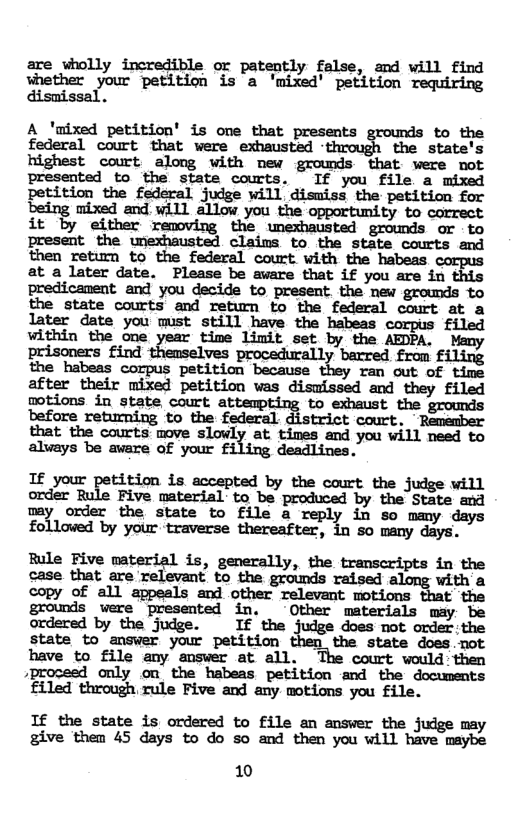
When
forms
are wholly incredible or patently false, and will find
whether your petition is a 'mixed' pefition requiring
dismissal.
A 'mixed petition' is one that presents to the
federal court that were exhausted 'flmmsute's
Rule Five material is, generally, the transcripts in the
case that are relevant to the raised along with a
copy of all appeals and other relevant motions that the
grounds wvere presented in. -Other materials may be
ordered by the judge. If the judge does mot order:the
state to answer your petition then the state does.not
have to file any amswer at all. The court would: then
sproceed only on_ the habeas petition and the documents
=
¥
&
7
I3
88
ig
s
H
H
%
4
sep GRESRESIE MANESESsl g1 §TRGONE
mm Libfi e & i
B gpesds [ Lt LR Iz
mmm m“mmm mm mmmmmwmwm.mm mmmmm mm
mmm yi¥ faify 7w mmwmm i mm& mmum
ettt Mww TR h
4 il L 84 i hmwm,*
alte wmm mfi mmmmfimm mhm mmwm&
11
3
i1
Ti5sd
I£ you only file a motice of appeal the Federal Gircuit
Court will take the notice of
appeal as a request for a
certificate of appealability and the Federal Gircuit
12
]
e
§
E
E
1
:
R ORRRESS
8
¢
E
g
I
g
E
icate of appealability is issued you will
a petition for a writ of certiorari with the
. Supreme Court. Though there are no forms available
a request for a federal district or federal
request for a certificate of appealability
are forms available for Filing a petition for a
writ of certiorari.
To
i
g
g
i
get forns you would mail a letter of request to the
Clerk of the United States Supreme Court, which might
sound like this: ’
Office of the Clerk
Please send me the forms and instructions needed to
file a petition for a writ of certiorari with your
court. Please also send me a current copy of the
rules of court.
The Clerk will send you a packet including the fill in
the blank forms, instructions and the rules of the U.S.
13
g
mmmmmwmm mm
ik
14
Rules Governing Section 2254 Cases in the United States District
Courts
Section 2254 Rule 1
Rule 1. Scope.
(a) Cases Involving a Petition Under 28 U.S.C. § 2254. These rules
a petition for a writ of habeas corpus filed in a United States district court
under 28 U.S.C. § 2254 by:
(1) a person in custody under a state-court judgment who seeks a
determination that the custody violates the Constitution, laws, o treaties of
‘the United States; and
(2) a person in custody under a state-court or federal-court judgment who
seeks a determination that fture custody under a state-court judgment
‘'would violate the Constitution, laws, or treaties of the United States.
(b) Other Cases, The district court may apply any or all of these rules to a
habeas corpus petition not covered by Rule I(a). [4mended effective Dec. 1,
2004]
Section 2254 Rule 2
(8) Current Custody; Naring the Respondent. If the petitioner is currently
in custody under a state-court judgment, the petition must name as
respondent the state officer who has custody.
(b) Future Custody; Naming the Respondents and Specifying the Judgment.
If the petitioner is not yet in custody=-but may be subject to future custody~-
under the state-court judgment being contested, the petition must name as
respondents both the officer who has current custody and the attorey
general of the state where the judgment was entered. The petition must ask
for relief from the state-court judgment being contested. 15
Form. The petition must:
1) specify all the grounds for relief available to the petitioner;
2) state the facts supporting each ground;
3) state the relief requested;
) be printed, typewritten, or legibly handwritten; and
S)knmndundupmn)tynfpajwybylthmflmflmhyapm
thorized to sign it for the petitioner under 28 US.C. § 2242.
) Standard Form. The petition must substantially follow either the form
pended to these rules or a form prescribed by a local district-court rule.
1e clerk must make forms available to petitioners without charge.
) Separate Petitions for Judgments of Separate Courts. A pefitioner who.
ek relief from judgments of more than one state court must file a separate’
sition covering the judgment or judgments of each court. [Amended
Tective Dec. 1, 2004.]
Section 2254 Rule 3
ule3. Filing the Petition; Inmate Filing.
) Where to File; Copies; Filing Fee. An original and two copies of the
tition must be filed with the clerk and must be accompanied by:
(1) the applicable filing fee, o -
(2) a motion for leave to proceed in forma pauperis, the affidavit required
by 28 U.S.C. § 1915, and a certificate from the warden or other appropriate
officer of the place of confinement showing the amount of money or
securities that the petitioner has in any account in the institution.
(b) Filing. The clerk must file the petition and enter it on the docket.
(©) Time to File. The time for iling a pefition is governed by 28 US.C. §
244(d).
(@) Inmate Filing. A paper filed by an inmate confined in an institution is
timely if deposited in the institution's internal mailing system on or before
the last day for fling, If an institution has a system designed for legal mail,
the inmate must use that system to reccive the benefit of this rule. Timely
filing may be shown by a declaration in compliance with 28 U.S.C, § 1746
or by anotarized statement, either of which must set forth the date of
deposit and state that first-class postage has been prepaid. [Amended
effective Dec. 1, 2004
Section 2254 Rule 4
Rule 4. Preliminary Review; Serving the Pefition and Order. The clerk must
promptly forward the petition to a judge under the court’s assignment
procedure, and the judge must promptly examine it. If it plainly appears
from the petition and any attached exhibits that the petitioner is not entitled
to relief in the district court, the judge must dismiss the peition and direct
the clerk to notify the petitioner. If the pefition is not dismissed, the judge
must order the respondent to file an answer, motion, or other response
wiminlfixedfime,oswhhmwfimmjndgemymdnhway
case, the clerk must serve a copy of the petition and any order on the
respondent and on the attomey general or other appropriate officer of the
state involved. [Amended effective Dec. 1, 2004.)
Section 2254 Rule 5
Rule 5. The Answer and the Reply. 17
(2) When Required. The respondent is not required to answer the petition
unless a judge 5o orders. :
(b) Contents: Addressing the Allegations; Stating a Bar. The answer must
address the allegations in the petition. In addition, it must state whether
claim in the petition is barred by a failure to exhanst state remedics, a-
procedural bar, non-retroactivity, or a statute of limitations.
(¢) Contents: Transcripts. The answer must also indicate what transcripts (of
pretrial, tril, sentencing, ar post-conviction proceedings) are available,
‘when they can be furnished, and what proceedings have boen recorded but
ot transcribed. The respondent must attach to the answer parts of the.
transeript that the respondent considers relevant. The judge may order that
the respondent furnish other parts of existing transcripts or that parts of
untranseribed recordings be transcribed and furnished. If & transcript cannot
‘be obtained, the respondent may submit a narrative summary of the
evidence.
(d) Contents: Briefs on Appeal and Opinions. The respondent must also file
‘with the answer a copy oft
(1) any bricf that the petitioner submitted in an appellate court conesting
the conviction or seatence, or contesting an adverse judgment or orderina
(2) any brief that the prosecution submitted in an appellate court relating
to the conviction or sentence; and
(3) the opinions and dispositive orders of the appellate court relating to
the conviction or the sentence.
18
(¢) Reply. The peitioner may submit a reply to the respondent's answer or
other pleading within a time fixed by the judge. [Amended effective Dec. 1,
2004]
Section 2254 Rule 6
Rule 6. Discovery.
(&) Leave of Court Required. A judge may, for good cause, authorize a part
o conduct discovery under the Federal Rules of Civil Procedure and may
it the extent of discovery. If necessary for effective discovery, the judge
‘must appoint an attomey for a petitioner who qualifies to have counsel
appointed under 18 U.S.C. § 3006A.
(b) Requesting Discovery: A party requesting discovery must provide
reasons for the request. The request must also include any proposed
mmwn'ummmmmwm‘ and must specify any requested
(¢) Deposition Expenses. If the respondent is granted leave to take a.
deposition, the judge may require the respondent to pay the travel expenses
subsistence expenses; and fees of the petitioners attomey to attend the
deposition. [Amended effective Dec. 1, 2004
Section 2254 Rule 7
Rule 7. Expanding the Record.
(2) In General. If the petition s not dismissed, the judge may direct the
parties to expand the record by submitting additional materials relating to
the petition. The judge may require that these materials be authenticated.
(b) Types of Materials. The materials that may be required include letters
predating the filing of the petition, documents, exhibits, and answers under
19
ato written interrogatories propounded by the judge. Affidavits may also
submitted and considered as part of the record.
Review by the Opposing Party. The judge must give the party against
om the additional materials are offered an opportunity to admit or deay
ir correctness. [Amended effective Dec. 1, 2004.)
Section 2254 Rule 8
le 8. Evidentiary Hearing.
Determining Whether to Hold a Hearing. If the motion is not dismissed,
judge must review the answer, any transcripts and records of prior
«ceedings, and any materials submitted under Rule 7 to determine
ether an evidentiary hearing is warranted.
Reference to a Magistrate Judge. A judge may, under 28 US.C. §
mmanmonnnmummmmdgemmd\mhnnwmdm
‘proposed findings of fact and recommendations for disposition. When
ymmmdnkmmmmpflymmafmmpmm
1 recommendations on all parties. Within 14 days after being served, a
Ay may file objections as provided by local court rule. The judge must
ermine de novo any proposed finding or recommendation fo which
jection is made. The judge may accept, reject, or modify any proposed
ding or recommendation.
1 Appointing Counsel; Time of Hearing. If an evidentiary hearing is
wrranted, the judge must appoint an attorney to represent a moving party
10 qualifies fo have counsel appointed under 18 U.S.C. § 3006A. The
ige must conduct the hearing as soon as practicable after giving the
‘omeys adequate time to investigate and prepare. These rules do not limit
+ appointment of counsel under § 3006A at any stage of the proceeding.
) Producing a Statement. Federal Rule of Criminal Procedure 26.2(a)-(d)
d (£ applies t haring under this rul. I a party docs not comply with a
Rule 26.2(a) order to produce a witness's statement, the court must not
consider that witness's testimony. [Amended effective Dec. 1, 2004; Dec. |
2009.)
Section 2254 Rule 9
Rule 9. Second or Successive Petitions. Before presenting a second or
successive petition, the petitioner must obtain an order from the appropria
court of appeals authorizing the district court to consider the petition as
required by 28 U.S.C. § 2244(b)(3) and (4). [Amended effective Dec. 1,
2004
Section 2254 Rule 10
Rule 10. Powers of a Magistrate Judge. A magistrate judge may perform t
duties of a district judge under these rules, as authorized under 28 U.S.C. {
636. [Amended effective Dec. 1, 2004
Section 2254 Rule 11
Rule 11. Certificate of Appealability; Time to Appeal.
(a) Certificate of Appealability. The district court must issue or deny a
certificate of appealability when it enters a final order adverse to the
applicant. Before entering the final order, the court may direct the parties t
submit arguments on whether a certificate should issue. If the court issnes
certificate, the court maust state the specific issue or issues that satisfy the
showing required by 28 U.S.C. § 2253(c)(2). If the court denies a
certificate, the parties may not appeal the denial but may seek a certificate
from the court of appeals under Federal Rule of Appellate Procedure 22. A
‘motion to reconsider a denial does not extend the time to appeal.
(®) Time to Appeal. Federal Rule of Appellate Procedure 4(a) governs the
time to appeal an order entered under these rules. A timely notice of appeal
‘must be filed even if the district court issues a certificate of appealability.
[Adopted Mar. 26, 2009, effective Dec. 1, 2009.)
Section 2254 Rule 12
le 12. Applicability of the Federal Rules of Civil Procedure, The Federal
* statutory provisions o these rules, may be applied to a proceeding
ler these rules. [Amended effective Dec. 1, 2004; remumbered from Rule
Dec. 1, 2009.]
Model Forms
Petition for Relief From a Conviction or Sentence By a Person in
ite Custody * ’
ition for Relief From a Conviction or Sentence By a Person in State
stody
stition Under 28 U.S.C, § 2254 for a Writ of Habeas Corpus)
1. To use this form, you must be person who is currently
serving a sentence under a judgment against you in a state court.
You are asking for relief from the conviction or the sentence.
2. You may also yse this form to challenge a state judgment that
imposed a sentence to be served in the future, but you must fill
in the name of the state where the judgment was entered. If you
‘want to challenge a federal judgment that imposed a sentence to
e scrved in the future, you should file a motion under 2§
U.S.C. §2255 inthe federal court that entered the judgment.
3. Make sure the form s typed or neatly written.
4. You must tell the truth and sign the form. If you make a false
statement of a material fact, you may be prosecuted for perjury.
5. Answer all the questions. You do not need to cite law: You
‘may submit additional pages if necessary. If you do not fill out
™
the form properly, you will be asked to submit additional or
correct information. If you want to submit a brief or arguments,
you must submit them in a separate memorandum.
6. You must pay a fee of $5. If the fee is paid, your petition will
e filed. If you cannot pay the fee, you may ask to proceed in
forma pauperis (as a poor person). To do that, you must fill out
the last page of this form. Also, you must submit a certificate
signed by an officer at the institution where you are confined
showing the amount of money that the institution is holding for
you. If your account exceeds §_ you
‘must pay the filing fee.
7. In this petition, you may challenge the judgment entered by
only one court. If you want to challenge a judgment éntered by a
different court (either in the same state or in different states),
you must file a separate petition.
8. When you have completed the form, send the original and
two copies to the Clerk of the United States District Court at
Clerk, United States District Court for
Address
City, State Zip Code
9. CAUTION: You must inclnde in this petition all the
‘grounds for relief from the conviction or sentence that you
challenge. And you must state the facts that support each
ground. Ifyou fail to set forth all the grounds in this
petition, you may be barred from presenting additional
grounds at a later date.
10. CAPITAL CASES: If you are under a sentence of death,
you are entitled to the assistance of counsel and should
request the appointment of counsel.
PETITION UNDER 28 US.C. § 2254 FOR WRIT OF 2
ABEAS CORPUS BY A PERSON IN STATE CUSTODY
nited States District Court District
ame (under which you were convicted):
ace of Confinement: CASE OR DOCKET NRMEER
itioner (include the name under which Respondents
were convicted) (Person 1n):
(custody of prisoner)
1e Attorney General of the State of
CTITION
1. (a) Name and location of court that entered the judgment of
‘conviction you are challenging:
(1) Not guilty () Nolo contendere (no conte
@ Guilty (4) Insanity plea
(b) If you entered a guilty plea to one count or charge and a not guilty plea
to another count or charge, what did you plead guilty to and what did you
plead not guilty to?
() If you went to trial, what kind of trial did you have? (Check one)
Jury Judge only
7. Did you testify at a pretrial hearing, tial, or a post-trial hearing?
Yes No
8. Did you appeal from the judgment of conviction?
Yes No
9. If you did appeal, answer the following:
(2) Name of court:
(b) Docket or case number (if you know):
() Result:
(@) Date of result (f you know):
(e) Citation to the case (if you know):
!
i
!
Did you seek further review by a higher state court? Yes No
‘es, answer the following:
Name of court:
Docket or case number (if you know):
Result:
Date of result (if you know):
Citation to the case (if you know):
Did you file a petition for certiorari in the United States Supreme Court? ,
5 No
res, answer the following: '
(1) Docket or case mumber (if you know):
(2) Result:
(3) Date of result (if you know):
(4) Citation to the case (if you know):
10. Other than the direct appeals listed above, have you previously filed a
other petitions, applications, or motions concerning this judgment of
conviction in any state court?
Yes No
11. If your answer to Question 10 was "Yes," give the following
information:
(@) (1) Name of court:
(2) Docket or case mumber (f you know):
(3) Date of filing (if you know):
(4) Nature of the proceeding:
(5) Grounds raised:
27
(6) Did you receive a hearing where evidence was given on
‘your petition, application, or motion?
Yes No
(7) Result:
(8) Date of result (if you know):
(b) If you filed any second petition, application, or motion, give
the same information:
(1) Name of court:
(2) Docket or case number (if you know):
(3) Date of filing if you know):
(4) Nature of the proceeding:
(5) Grounds raised:
(6) Did you receive a hearing where evidence was given on
your petition, application, or motion?
Yes No
(7) Result:
(8) Dato of result (if you know):
() If you filed any third petition, application, or motio
the same information: * n,s'lve
(1) Name of court:
(2) Docket or case mumber (if you know):
(3) Dte of filing (i you know):
(4) Niiture of the proceeding:
(5) Grounds raised:
29
(6) Did you receive a hearing where evidence was given on
‘your petition, application, or motion?
Yes No
(7) Result:
(8) Date of result (if you know):
(d)mdywmpulmhhighmmmmhvingjmisdicfim
over the action taken on your petition, application, or motion?
(1) First Yes No
(2) Second Yes No
petition:
(3) Third Yes No
(&) If you did not appeal to the highest state court having jurisdiction,
*xplain why you did not:
lz.Fmdfispcdfiqn,mcvnymmdmwhichywc]mflmwun
xinghelflinviolnfiunofflwccmimfivn,llws,mmmofihel}nimd
‘he facts supporting each ground.
CAUTION:
To proceed in the federal court, you must ordinarily first exhaust
(use up) your available state-court remedies on each ground on
whichyomqmufim»ymefizegaumm.ifywm
10 set forth all the grounds in this petition, you may be barred.
from presenting additional grounds at a lter date.
GROUND ONE:
(a) Supporting facts (Do not argue or cite law. Just state the specific facts
l
!
(¢) Direct Appeal of Ground One:
p);{[ywwfimmj\umormmn‘mmmfis
issue
Yes No 31
) If you did not raise this issue in your direct appeal, explain why:
(d) Post-Convietion Proceedings:
{1) Did you raise this issue through a post-conviction motion or petition for
habeas corpus in a state trial court? .
Yes No
2) If your answer to Question (d)(1) is "Yes,"state:
Type of motion or petition:
Nmelndloufiunofihew\mwhmlbzmmimmpcfifimwfiled:
Docket or case mumber (if you know):
Date of the court's decision:
Result (attach a copy of the courts opinion or order, if available):
G)Didyonmm’veahuflngwnyo\n’mmionorp:fifiofl
Yes No
(4)Didywlypulfivmlhedmfil|ofyuwmmixmurpcfifim7
-
Yes No
(5) I£ your answer to Question (d)(4) is "Yes," did you raise this issue in the
appeal?
Yes No
(6) If your answer to Question (d)(4) is "Yes,” state:
'Name and location of the court where the appeal was filed:
Docket or case mumber (if you know):
Date of the court's decision:
Result (attach a copy of the court's opinion or order, if available):
(7) If your answer to Question (d)(4) or Question (d)(5) is "No," explain
why you did not raise this issue:
() Other Remedies: Describe any other procedures (such as habeas
corpus, administrative remedies, etc.) that you have used to exhaust your
state remedies on Ground One:
33
'ROUND TWO:
') Supporting facts (Do not argue or cite law. Just state the specific facts
1t support your claim.):
))lfyoudidnmexhlmyomsmmediflm&wndm.amlflnwbw:
<) Direct Appeal of Ground Two:
1) If you appealed from the judgment of conviction, did you raise this
ssue?
‘es No
Z)H'yfludidnmmiufllisimainymdhmmexplflnwhy:
Eal
(@ Post-Convietion Proceedings:
(1) Did you raise this issue through a post-conviction motion or petition for
habeas corpus in a state trial court?
Yes No
(2) 1 your answer to Question (d)(1) i "Yes," state:
Type of motion or petition:
Name and location of the court where the motion or petition was filed:
Docket or case number (if you know):
Date of the court's decision:
Result attach 2 copy of the court's opinion or order, if available):
(%) Did you receive a hearing on your motion or petition?
Yes No
(4) Did you appeal from the denial of your motion or petition?
Yes No
(5) If your answer to Question (d)(4) is "Yes," did you raise this issue in_‘fl‘w
Yes No
(6) If your answer to Question (d)(4) is "Yes," state:
Name and location of the court where the appeal was filed:
Docket or case number (if you know):
Date of the court's decision:
Result (attach a copy of the court's opinion o order, if available):
(7) If your answer to Question (d)(4) or Question (d)(5) is "No," explain
why you did not raise this issue:
(€) Other Remedies: Describe any other procedures (such as habeas
wrmu,minimafivemediu‘m)‘hnmmuedmmmyw
state remedies on Ground Two:
GROUND THREE:
(a) Supporting facts (Do not argue or cite law. Just state the specific facts
that support your claim.):
‘
(b) I£ you did not exhaust your state remedies on Ground Three, explain
why:
(¢) Direct Appeal of Ground Three:
(1) £ you appealed from the judgment of conviction, did you raise this
issue?
Yes No
(2)Xf you did not raise this issue in your direct appeal, explain why:
37
d) Post-Conviction Proceedings:
2) If your answer to Question (d)(1) is "Yes," state:
Type of motion or petition:
Nflmpnndloufimoffltwmwbuelb:mofimwpfiificmwufiled:
Docket or case number (if you know):
Date of the court's decision:
Result (attach a copy of the courts opinion or order, if available):
3) Did you receive a hearing on your motion or petition?
Yes No
(4) Did you appeal from the denial of your motion or petition?
Yes No
(5) I your answer to Question (d)(4) is "Yes," did you raise this issue in the
appeal?
Yes No
38
(6) 1f your answer to Question (d)(4) is "Yes,” sate:
Name and location of the coust where the appeal was filed:
Docket or case number (if you know):
Date of the court's decision:
Result (attach a copy of the courts opinion or order, if available):
(7) If your answer to Question (d)(4) or Question (d)(5)is "No," explain
‘why you did not raise this issue:
(c) Other Remedies: Describe any other procedures (such as habeas
corpus, administrative remedies, etc.) that you have used to exhaust your
Mmmfiwmdm
‘GROUND FOUR:
(a) Supporting facts (Do not argue or cite law. Just stat~ the specific facts
that support your claim ): 29
)1 you did not exhaust your state remedies on Ground Fou, explain why:
©) Direct Appeal of Ground Four:
1) If you appealed from the judgment of conviction, did you raise this
ssue?
Yes No
:Z)Ifywdidnmmisfihisimeinyowfihectlppdexpllinwhy:
d) Post-Conviction Proceedings: w©
1) Did you raise this issue through a post-conviction motion or petiion for
sbeas corpus in a state trial court?
fes No
2) If your answer to Question (d)(1)is "Yes," state:
ype of motion or petition:
Yame and location of the court where the motion or petition was filed:
docket or case mumber (if you know):
Jate of the court's decision:
Resul (attach a copy of the courts opinion o order, if available):
3) Did you receive a hearing on your motion ot peition?
fes No
4) Did you appeal from the denial of your motion or petition?
fes No
5) If your answer 1o Question (d)(4) is "Yes," did you raise this issue in the
appeal?
Yes No
(6)1f your answer to Question (d)(4) is "Yes," state:
Name and location of the court where the appeal was filed: i
_—
-
Docket or case mumber (if you know):
Date of the court's decision:
Result (attach a copy of the court's opinion or order, if available):
_
(7) I your answer to Question (d)(4) or Question (d)(5) is ™No," explain
‘why you did not raise this issue:
(¢) Other Remedies: Describe any other procedures (such as habeas
corpus, administrative remedies, etc.) that you have used to exhaust your
13. Please answer these additional questions about the peition
you are filing:
(2) Have all grounds for relief that you have raised in this
pefifianbempmdwmhighmmmhwing
jurisdiction? Yes No 45
If your answer is "No," state which grounds have not been so
presented and give your reason(s) for not presenting them:
(b) Is there any ground in this pefition that has not been
preseated in some state or federal court? If so, which ground or
‘grounds have not been presented, and state your reasons for not
presenting them:
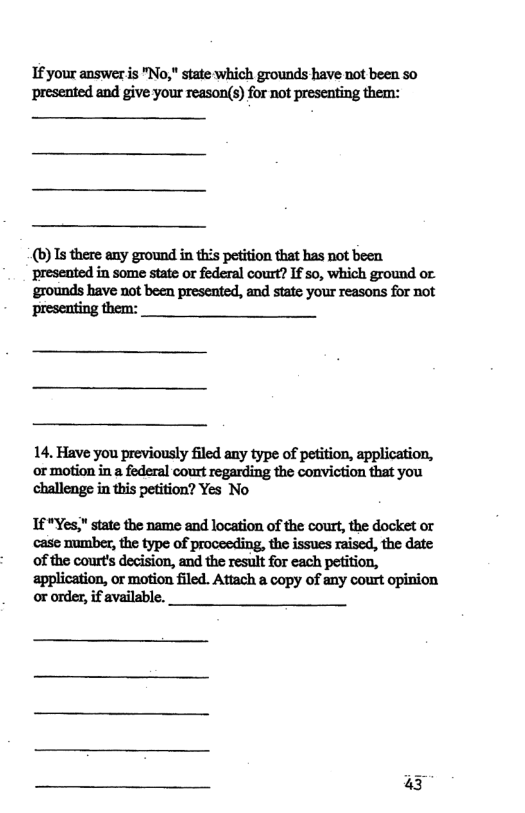
14. Have you previously filed any type of petition, application,
‘or motion in a federal court regarding the conviction that you
challenge in this petition? Yes No
If "Yes," state the name and location of the court, the docket or
case number, the type of proceeding, the issues raised, the date
‘of the court's decision, and the result for each petition,
application, or motion filed. Attach a copy of any court opinion
or order, if available.
43
-_—
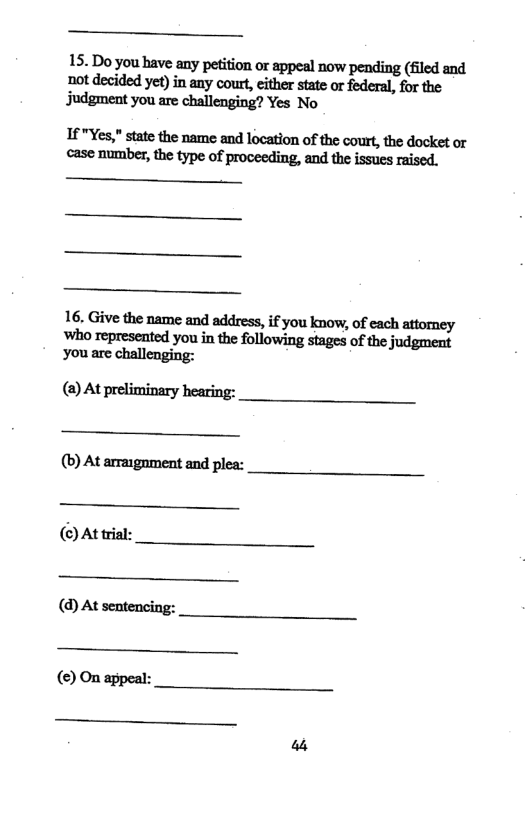
15. Do you have any petition or appeal now pending (fled and
not decided yet) in any cour, either state or federal, for the
judgment you are challenging? Yes No
If "Yes," state the name and location of the court,the docket o
case number, the type of proceeding, and the issues raised.
-
-
16. Give the name and address, if you know, of each attorney
‘who represented you in the following stages of the judgment
you are challenging:
() At preliminary hearing:
(b) At arraignment and plea:
(©) At trial:
(d) At sentencing:
() On appeal:
_—
() In any post-conviction proceeding:
(2) On appeal from any ruling against you in a post-conviction
proceeding: .
17. Do you have any future sentence to serve afier you complete
the sentence for the judgment that you are challenging? Yes No
() If 50, give name and location of court that imposed the other
sentence you will serve in the future:
(b) Give the date the other sentence was imposed:
(¢) Give the length of the other sentence:
(@) Have you filed, or do you plan to file, any petition that
challenges the judgment or sentence to be served in the future?
Yes No
18. TIMELINESS OF PETITION: If your judgment of
conviction became final over one year ago, you must explain
‘why the one-year statute of limitations as contained in 28 US.C.
§2244(d) does not bar your petition. *
45
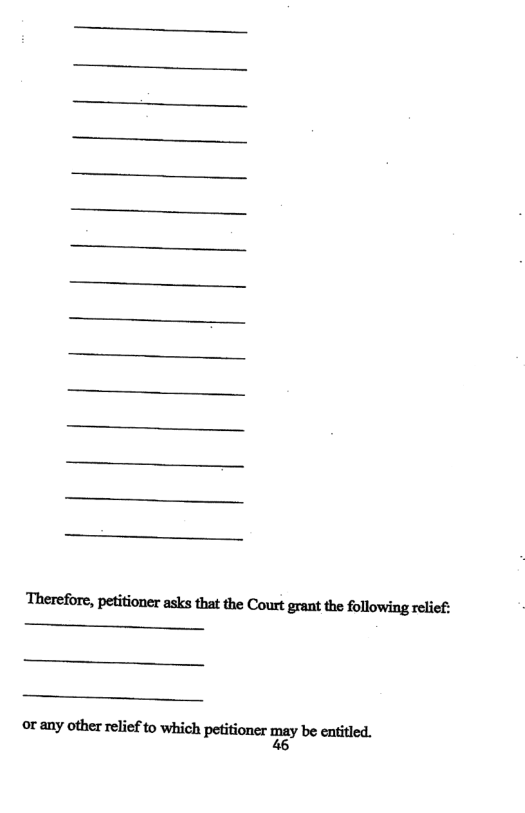
Therefore, petitioner asks that the Court grant the following relief:
_
_
_
wmymbunfiefmwhi:hpdifimulz:gybeenm
Therefore, petitioner asks that the Court grant the following relief:
or any other relief to which petitioner may be entitled.
Sigaature of Attomey (if any)
1 declare (or certify, verify, or state) under penalty of perjury that the
Toregoing is true and correct and that this Petition for Writ of Habeas
Corpus was placed in the prison mailing system on
(month, date, year).
Executed (signed) on (date).
Signature of Petitioner
If the person signing is not petitioner, state relationship to petitioner and
47
4mended effective Dec. 1, 2004]
In Forma Pauperis Declaration
1 Forma Pauperis Declaration
1 Forma Pauperis Declaration
‘nsert appropriate court)
'DECLARATTON
Movant) OF REQUEST
TO PROCEED
N FORMA PAUPERIS
., declare that T am the movant in the above entitled case; that
lmxppoflnfmymnfimmpomdwithmnbeing:eqlfiledmmfies,
2sts or give security therefor, I state that because of my poverty, I am
aable to pay the costs of said proceeding or to give security therefor; that
slieve I am entitled o relief.
- Are you presently employed?
s No
If the answer is "yes,” state the amount of your salary or wages per
onth; and give the name and address of your employer.
If the answer is "no,” state the date of last employment and the amount of
te salary and wages per month which you received.
Have you received within the past twelve months any money from any of
‘e following sources?
Business, profession or form ofslf-cmployment?
Yes No
b. Rent payments, interest or dividends?
Yes No
. Pensions, annuities or life insurance payments?
Yes No
d.Gifts or ineritances?
Yes No
e. Any other sources?
Yes No
‘If the answer to any of the above is "yes," describe each source of money
and state the amount received from each during the past twelve months.
3. Do you own any cash, or do you have money in a checking or savings
account?
Yes No (Include any funds in prison accounts)
Ifthe answer is "yes," state the total value of the items owned.
4. Do you own real estate, stocks, bonds, notes, automobiles, or other
abuableproery (exluding ordinary boschold fumishings andclofing)?
les No
If the answer is "yes," describe the property and state its approximate value.
5. List the persons who are dependent upon you for support,
state your relationship to these persons, and indicate how much you
contribute toward their support:
49
oregoing is true and correct. Exeouted on
date)
penalty of perjury that the
hereby certify that the movant herein
«ccount to his credit at the ...
‘Officer of Institution
Model Form for Use in 28 U.S.C. § 2254 Cases Involving a Rule 9
ssue [dbrogated )
MMFWMUEEWCMMWAMQ
ssue (Form No. 9), captioned "Petitioner's Response as to Why His Petition
should Not Be Barred Under Rule 9," was abrogated, effective December 1,
1007.
() Certificate of Appealability.
(1) In a habeas corpus proceeding in which the detention complained of
arises from process issued by a state court, or in a 28 US.C, § 2255
*proceeding, the applicant cannot take an appeal unless a cirouit justice or a
circuit or district judge issues a certificate of appealability under 28 S.C.
§2253(c). If an applicant files a notice of appeal, the district judge who
rendered the judgment must cither issue a certificate of appealability or state
why a certificate should not issue. The district cleck must send the
certificate or statement to the court of appeals with the notice of appeal and
the file of the district court proceedings. If the district judge has denied the
certificate, the applicant may request a circuit judge to issue the certificate.
(2) A request addressed to the court of appeals may be considered by a
circuit judge or judges, as the court prescribes. If no cxpress request for a
certificate is filed, the notice of appeal constitutes a request addressed to the
judges of the court of appeals.
(3) A certificate of appealability is not required when a state or its
representative or the United States or its represcntative appeals. [Adopted
1967 last amended December 1, 1998.]
51
FOOTNOTES:
Footnote 1. Published in Moore's Rules Pamphlet, Part 3, Habeas Corpus
Rules.
Footnote 2. Published in Moore's Rules Pamphiet, Part 3, Habeas Corpus
Rules.
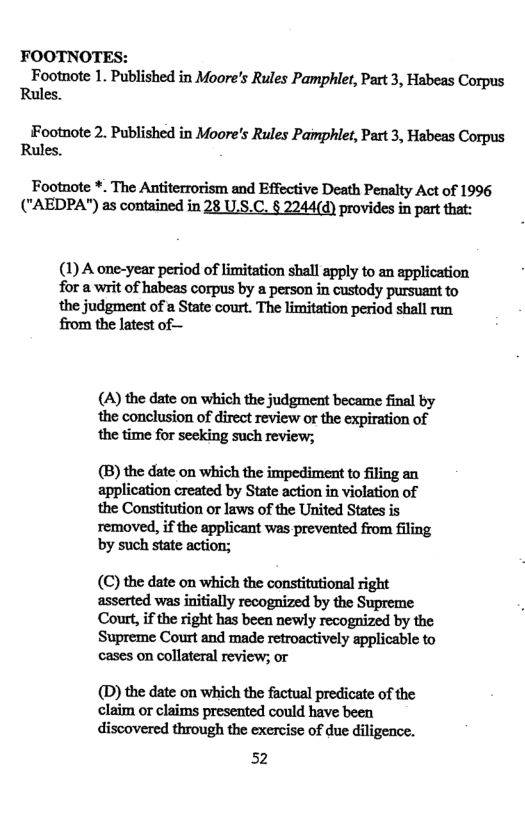
Footnote *. The Antiterrorism and Effective Death Penalty Act of 1996
("AEDPA") as contained in 28 U.8.C. § 2244(d) provides in part that:
(1) A one-year period of limitation shall apply to an application
for a it of habeas corpus by a person in custody pursuant to
the judgment of a State court. The limitation period shall run
from the latest of—
(A) the date on which the judgment became final by
‘the conclusion of direct review or the expiration of
(B) the date on which the impediment to iling an
application created by State action in violation of
the Constitution or laws of the United States is
removed, if the applicant was prevented from filing
by such state action;
(C) the date on which the constitutional right
asserted was initially recognized by the Supreme
Coutt, if the right has been newly recognized by the
Supreme Court and made retroactively applicable to
cases on collateral review; or
(D) the date on which the factual predicate of the
claim or claims presented could have been
discovered through the exercise of due diligence.
52
(2) The time during which a properly filed application for State
post-conviction or other collateral review with respect to the
‘pertinent judgment or claim is pending shall not be counted
toward any period of limiafion under this subscction.
53
Booklets and Zines mentioned in this booklet may be
requested from ome of the books to prisomers outfits
listed below. Please keep in mind that books to
prisoner’s outfits make reading materials available for
prisoners using Volunteers and donations. These items
and postage to mail them has a price. So, PLEASE DONATE
funds of any amount or embossed envelopes or other
postage when you can, to a books to prisoner's outfit.
REDBIRD BOOKS TO PRISONERS
P.0. Box 10599
Columbus Ohio 43201
MIDVEST PAGES TO PRISONERS PROJECT
c/o Boxcar Books
408 East 6th Street
Bloomington Indiana 47408
ATHENS BOOKS TO PRISONERS
P.0. Box 45
Rutland Chio 45775
MIDWEST BOOKS TO PRISONERS
1321 N. Milvaukee Averue
BB 460
Chicago, IL 60622
CENTRAL TEXAS ABC
ABC Para-Legal Services
P.0. Box 7187
Austin Texas 78713
LEFT BANK BOOKS
Books To Prisoners
92 Pike Street
Box A
Seattle Washington 98101
SOUTH CHICAGO ZINE DISIRO
P.0. Box 154
‘Homewood IL 60543
54
Other Books and Zines
By Pauper's Press and . M. Salerno
How to use’the law library and write your own law work
Criminal law case citator
Crininal law forms
Criminal law concepts
An Ohio Prisoner's Guide to Disciplinary Proceedings
Modification of Parenting Orders n
The Paths Less Travelled Through the Gdurts
Tree Bark and Stone [Survival Tactics and, Nature)
A Letter From Home R i -
The Injustice of Solitary’, ’
How To
11 Tf Someons Ts Lying To Yoir
Legacy
The Psychology of Self-Esteen’
... And Many Other Zines...
Newsletters by Salerno / Pauper's Press
From The Bench Newslerter
This is a pro-se litigant's resource and contains a
variety of articles in each issue that may help a
prisoner litigant learn about legal doctrine, how to
draft documents, changes” in law,. procedure and general
legal knowledge. Tnisipewsletter is normally publisned
four to six times each year, The.actual number of issuas
may vary due to availability of .resources needed to
produce*it.
55
Brought To You By:
“The Pawper Press
Rad@icd Bosks fu Plonus
Pe. Bx 19599
A Pauper's Press Publication
In conjunction with:
CT ABC / ABC Para-Legal Services
Redbird P.A./ Books 2 Prisoners
The Salerrio. Research Group
South Chicago ABC
é Zine Distro
P.0. Box 721
Tlomewood, IL 60430
Written and Compiled by:
D. Michael Salerno
P.0. Box 57 #412-224
Marion Chio 43301
. freesalerno.con